“Once I started to overcome the tragedies in my life, I started getting recognition. That and support motivated me to carry on. It made me more disciplined to stick to a routine. I could forget my problems and remain happy and avoid negativity.”
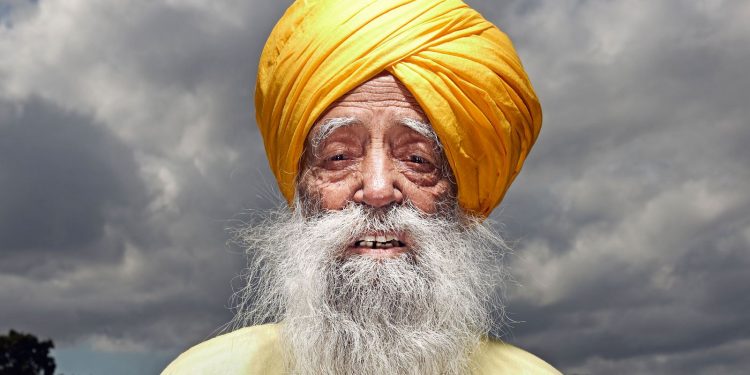
Fauja Singh, believed to be the world’s oldest marathon runner was killed at the age of 114 after being hit by a car in his birth village Beas Pind, Punjab.
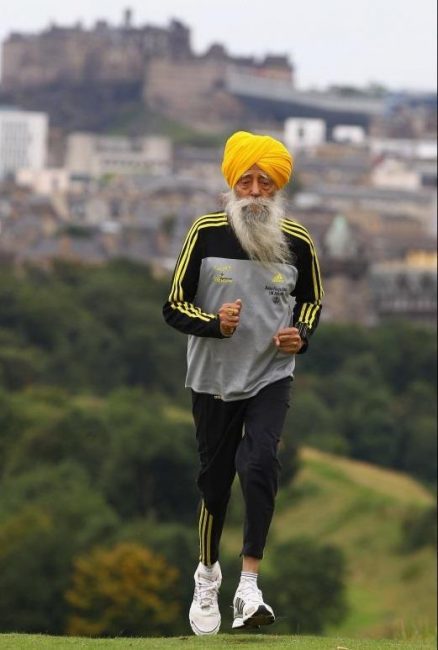
Picture credit: Fauja Singh Facebook
Police reported he suffered fatal injuries while trying to cross the road and passed away in the hospital on July 14.
Fauja Singh, became a global inspiration after he set marathon records over multiple age categories.
He started running in 1994 after the death of his son Kuldip, but it was not til 2000 at the age of 89 that he decided to pursue running seriously.
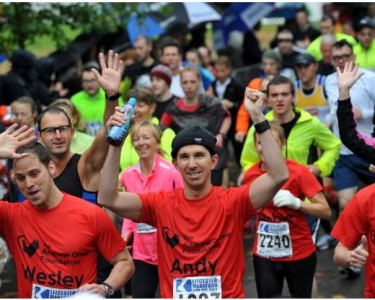
That same year, he rose to fame when he ran the London Marathon and finished the race in six hours and 54 minutes.
Singh said that before the race, he was told he could not wear a turban and would have to wear a patka (head covering worn by Sikhs.)
“I refused to run without my turban. Eventually the organisers allowed me to run with it, and for me, that’s my biggest achievement.”
He then ran the London marathon three successive times and by 2003 he had been signed by Adidas to appear in their Nothing Is Impossible campaign alongside icons such as Muhammad Ali and David Beckham.
Picture credit: Fauja Singh Facebook
Following this, he was invited by the Prime Minister of Pakistan in 2005 to participate in the inaugural Lahore Marathon. By 2006, he received a special invite from Queen Elizabeth II to visit Buckingham Palace.
Fauja Singh completed nine marathons between 2000 and 2013. His personal best came in Toronto in 2003, at five hours and forty minutes and it is believed he became the first centenarian to run a marathon as well as setting the world record for his age group.
“Almost after every training session in London, I used to go to the gurdwara, where my diet was taken care of. Everyone there motivated me to run long distances,” he said.
He competed well into his 100s and earned the nickname ‘Turbaned Tornado,’ retiring after serving as a torchbearer at the London 2012 Olympics. His final competitive race came in Hong Kong in 2013 where he completed a 10km run in one hour, thirty two minutes and twenty eight seconds.
Harminder Singh, his coach at Sikhs In The City, described him as “an icon of humanity and a powerhouse of positivity.”
Singh credited his health and long life to a simple lifestyle and disciplined diet of ginger curries, alongside regular meditation.
In June 2025 he said: “Eating less, running more, and staying happy- that is the secret behind my longevity. This is my message to everyone.”
Alongside his running achievements, Fauja Singh received many awards. Notably, the Pride of India Award in 2011 and the Ellis Island Medal of Honor by the National Ethnic Coalition on November 13, 2003 for being a symbol of racial tolerance. He was the first non-American to receive the honour.
His running club and charity Sikhs in The City released a statement following his death and asked “In lieu of flowers please donate to his Clubhouse Appeal so we can carry on his legacy to encourage the world to keep fit and stay positive.”
By Tavjyot Kaur