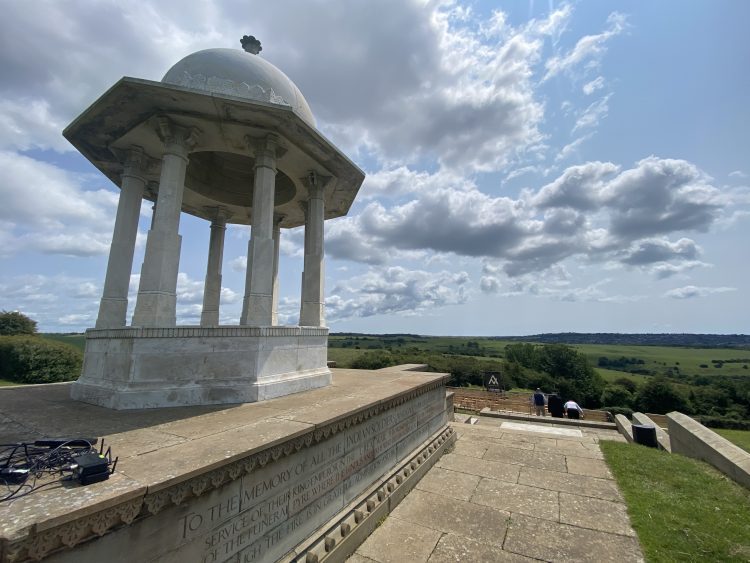
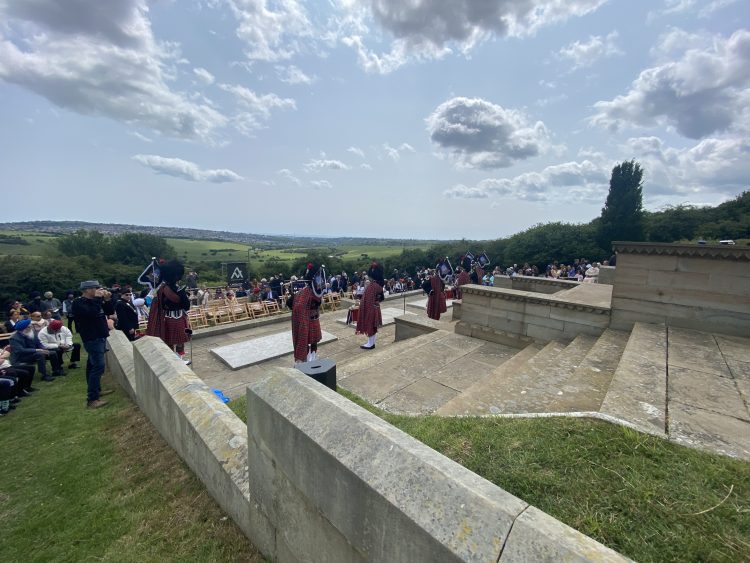
As the nation prepares to mark Victory over Japan (VJ) Day, a solemn ceremony was held at the Chattri Memorial in Brighton, to honour the thousands of Indian soldiers who fought and died in the First and Second World Wars.
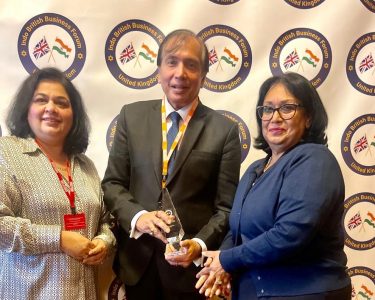
Led by Davinder Singh Dhillon, Deputy Lieutenant of East Sussex, the annual commemoration on Sunday (June 8), paid tribute to the Indian soldiers of the undivided Indian subcontinent — now India, Pakistan, Bangladesh, and parts of Afghanistan — who served alongside British forces, particularly during the First World War.
Picture credit: Pukaar News
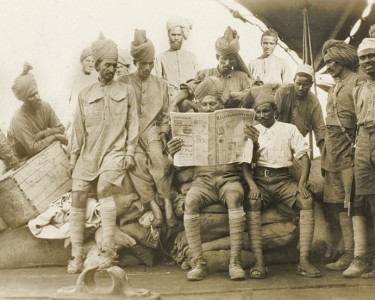
“These soldiers came from far away, as volunteers, to support British troops on the Western Front,” said Mr Dhillon. “They were brought over to France and Belgium to hold the line against the German advance. They did that admirably, with many awarded citations for bravery, including the Victoria Cross and the Indian Order of Merit.”
Over 1.5 million Indian troops were deployed during the First World War, forming the largest volunteer army at the time. Their contributions extended across Europe, Africa, and the Middle East, and the pattern repeated in the Second World War, where once again Indian forces played a crucial role.
The Chattri Memorial, built on the site where 53 Hindu and Sikh soldiers were cremated in accordance with their faiths, stands as a lasting symbol of their sacrifice. Nineteen Muslim soldiers were taken to Woking and buried near the Shah Jahan Mosque.
“This is about more than remembrance,” said Mr Dhillon, who has helped maintain the annual service since 2000. “This is about recognising the Indian contribution to British history, which is often forgotten and rarely mentioned in textbooks. We must remember that we stand on their sacrifice.”
The event, believed to be the only one of its kind in Britain, also featured remarks by Squadron Leader Rana Chhina, a military historian from the United Service Institution of India. He praised the efforts of the Chattri Memorial Trust for preserving the site and its significance.
Picture credit: Pukaar News
“This is a hallowed place,” he said. “It allows us to remember those who travelled thousands of miles to fight in a conflict that changed world history. For the South Asian community now living in Britain, this is part of our shared heritage.”
Chhina was closely involved in India’s Great War Centenary Commemoration Project and highlighted the importance of recognising India’s global role in both World Wars. “Very few people remember them,” he said. “But their contributions helped shape the world as we know it today.”
Attendees included descendants of soldiers, some laying wreaths in memory of their ancestors. One young woman, whose grandfather Hajinger Singh Dhatt MBE served on the Burma Front in the Second World War, spoke emotionally about the significance of the day.
“This is the first time I’ve attended without my grandfather,” she said. “We used to come every year together. Today is not just about remembering the fallen in war, but also remembering him.”
One attendee from Birmingham described the ceremony as “very moving and heartfelt.”
The annual commemoration was originally established in 1951 by the Royal British Legion and has continued without interruption, even during the COVID-19 pandemic.
“This ceremony is our duty,” said Mr Dhillon. “We must remember our ancestors — Hindus, Muslims, and Sikhs — who fought for freedom, for this country, and against tyranny. Their legacy is the freedom we enjoy today.”