By Romail Gulzar
Shockat Adam, the Independent MP for Leicester South, often says that every time he walks through Parliament, he still feels amazed.
Eighteen months into the job, he has not forgotten where he started or the city that shaped him. His journey is one that begins in Malawi, connects to India, and finds its true home in Leicester.
Adam was born in Malawi during the 1970s, a time of great upheaval for many East African Asian families. The situation in Uganda under Idi Amin created ripple effects across the region, and many families of Indian heritage were forced to leave. As part of the British diaspora, Adam’s family was invited to come to the UK, and he arrived here as a three-year-old child. “This country took me in,” he says. “It shaped me, nurtured me, and made me who I am.”
His parents were Gujarati and carried strong ties to India, but Britain quickly became home. Adam grew up with a strong sense of being both British and rooted in his family’s culture and history. “I’m a perfect combination of the two,” he explains. “I have my roots and identity, and I also have the life this country gave me.”
Leicester is at the heart of his story. He describes himself as “a Leicester boy through and through.” After attending Eastpark Primary- where the roof leaked during assemblies – he moved to Crownhills Community College, a tough but important part of his upbringing. Then came QE Wigston and later Manchester University. Although he lived in different cities and even abroad for a few years, he always returned home. “Leicester is very special,” he says. “Sometimes you don’t realise it until you leave.”
His favourite parts of the city are the places where Leicester’s incredible diversity shows itself—Abbey Park, Victoria Park, Spinney Hill, Bradgate Park. He loves seeing people from different cultures and religions come together. “That, for me, is the most wonderful part of Leicester,” he says.
Football is another big part of his connection to the city. As a child, when most of his classmates supported Liverpool, Adam was one of the few who supported Leicester City. His first football match, where Gary Lineker was on the bench, made him a lifelong fan. He has passed that love on to his children, even when the team struggles. “If anyone outside Leicester criticises the city or the club,” he says, “we defend it straight away.”
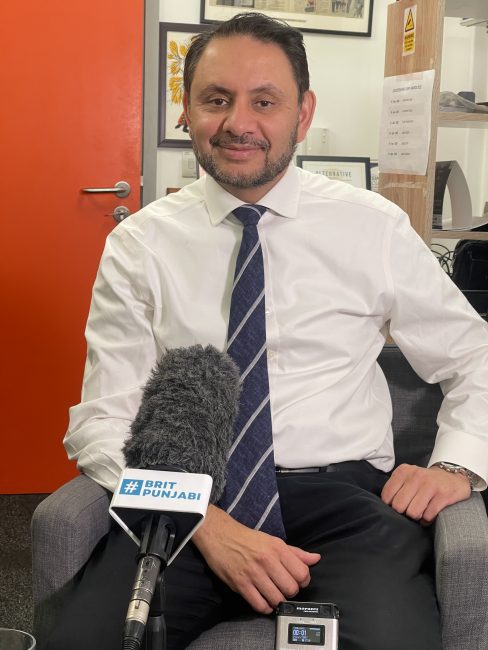
Adam believes strongly that Leicester should be proud of itself. “We have an inferiority complex,” he says. “We should talk more loudly about all the wonderful things in our city.”
His decision to enter politics came from witnessing hardship and injustice. As an NHS optometrist with his own practices, he was doing well in life. But the 2008 financial crisis opened his eyes. He saw how ordinary people paid the price for mistakes made by the wealthy. “That didn’t feel right,” he explains. During the Brexit years, he also noticed an increase in racist and xenophobic language. “People in suits, on TV and in Parliament, were saying things openly that I never expected to hear in Britain.”
He felt there was no one giving a voice to people like him—so he decided to step forward. Running as an Independent showed that politics is not only for the privileged. “If a boy from Highfields, whose parents didn’t speak English, who studied at Crownhills, can get into Parliament, then any young person can,” he says. “That gives people hope.”
Since becoming MP, Adam has spoken more than 160 times in Parliament. He has raised issues around poverty, elderly care, the two-child benefit cap, protection for pregnant women, the cost of living, and renters’ rights. His very first question to the Prime Minister was about reversing the changes to winter fuel payments.
Small businesses are another area he focuses on. After speaking with shop owners on Granby Street, hotel owners, and other traders, he knows their main concerns: lack of parking, anti-social behaviour in the city centre, rises in national insurance and rates, and higher staffing costs. He has raised these issues repeatedly in Parliament. “When our small businesses do well, the whole city does well,” he says.
The NHS is close to his heart, as he still practises as an optometrist. He believes that improving the NHS requires more than money. Housing, youth opportunities, addiction support, and education all need to work together. “Everything is linked,” he explains. “If people don’t have stability, it affects their health.”
Being a Muslim MP brings challenges. Adam receives racist abuse, including threats. The abuse became so bad on one social media post—simply showing two brown schoolchildren—that he had to remove it. “There is a lot of toxicity,” he says. “But there are more good people than bad. We must work together to fight racism and division.”
For Adam, unity is essential. He believes we must talk openly—even about difficult issues—to avoid building resentment. “We must build bridges, not burn them,” he says.
His message to the people of Leicester is simple: be part of the change. “If you want something to improve, come to me. We will work on it together. Change starts with us.”
He still remembers one moment in Parliament very clearly. On his first day in the Chamber, the Home Secretary pointed him out to the Prime Minister. The Prime Minister turned, looked directly at him, and nodded. “That was the moment it hit me,” Adam says. “The little boy from Highfields—standing there, recognised by the Prime Minister. It was a very proud moment.”