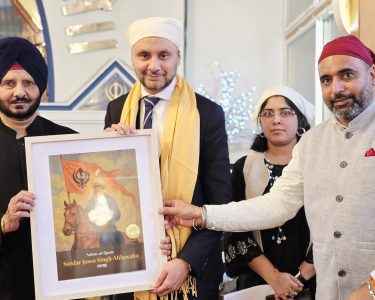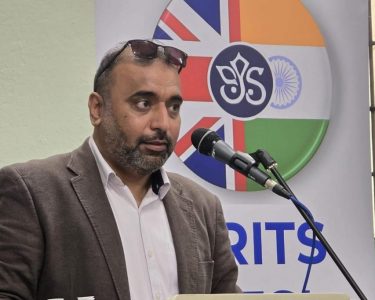
For more than three decades, Leicester filmmaker, author and historian Bobby Singh Bansal has dedicated his life to uncovering and sharing stories from Sikh history – a passion that began with a single moment of curiosity when he was just 19.
Born and raised in Leicester, Bansal attended Mela Junior School on Melton Road before going on to Northfields, Rushey Mead and Soar Valley School, and later City of Leicester College in Evington. Although he has lived and worked elsewhere, including London, the city has always remained at the centre of his life.
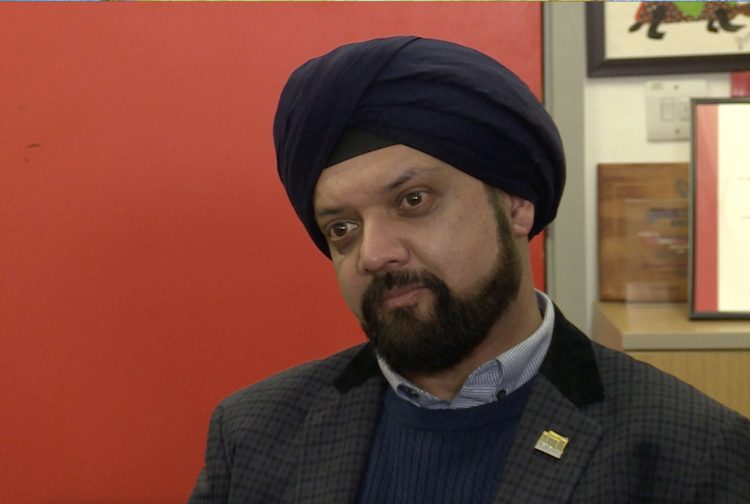
Picture credit: Pukaar News
“Wherever I go in the world I always end up back in Leicester,” he says. “This is home. My family’s always been here – this is the starting point and the end point.”
His path into history was anything but conventional. Bansal did not attend university, instead taking a number of courses in construction, engineering and history while building a career in business.
“I got into business at a very early age,” he says. “We were in the clothing business to begin with and in the late 1990s I started an import business in London. My office was in Belgium and I was very busy with work.”
At the time, researching history was simply a hobby – something he pursued out of personal fascination rather than professional ambition. That fascination, however, began decades earlier during a trip to Pakistan in 1989.
At 19, a friend from Birmingham handed him a Sikh history magazine and suggested he look at the final pages. There, Bansal found two photographs of Sikh maharajas with a note beneath them stating they were buried in Elveden, Suffolk.
“I thought Suffolk’s only two hours down the road,” he recalls. “I was surprised that there was a Sikh maharaja buried in England.”
That weekend he and a friend drove to see the grave. The visit sparked something that would shape the next 35 years of his life.
“I started researching more, going to libraries and reading books,” he says. “That’s when I discovered the Sikh Empire and realised it was the last kingdom in the region that was not under British rule. I was captivated.”
Determined to learn more, he decided to travel to Lahore – despite his parents’ initial concerns about him going to Pakistan at such a young age.
“But three months later I ended up there,” he says. “That journey mesmerised me.”
From that moment, Bansal began travelling regularly across the region, gradually building connections with academics, politicians and members of the military. Today he is frequently invited to Pakistan to give lectures and host exhibitions at universities.
“I’ve probably been to Pakistan more than India over the years,” he says. “The people have always been very kind and hospitable.”
Despite his growing knowledge, Bansal never initially planned to become an author. The turning point came years later after he got married.
“I used to tell my wife all these fascinating stories – about maharajas and kings and historical journeys,” he says. “One day she said to me, ‘What are you going to do with all this knowledge?’”
When he admitted he had no idea, she suggested he write a book.
“She said, ‘You should share these stories with other people.’ That’s really what motivated me.”
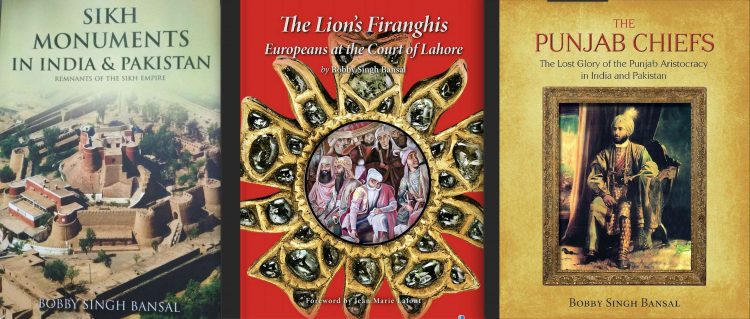
Picture: Some of Bobby Singh Bansal’s books
His first book, published in 2010, explored the court of Maharaja Ranjit Singh and the surprising role played by European officers in the Sikh army.
“He had around 30 to 40 Europeans serving under him – Italians, Spanish, French, Dutch, Germans and even Scottish and British officers,” Bansal says.
Fascinated by their journeys, he began tracking down their descendants across Europe.
“I went to their homes and looked through family archives,” he says. “We translated original handwritten letters – some of them took six months to a year. It was like putting together a giant jigsaw puzzle.”
The book was a success and quickly sold out. Since then, Bansal has gone on to publish five books, including work documenting Sikh monuments across Pakistan and research into the noble families of Punjab during the 19th century.
For him, rigorous research is essential.
“As an author you must obtain primary sources first,” he says. “You can’t rely on online information or newspaper articles that haven’t been researched properly. These books will be used by libraries and universities in the future.”
His commitment often requires painstaking fieldwork. While researching his latest book, Bansal travelled village by village across Punjab in search of descendants of historical figures.
“We’d leave at six in the morning and visit ten villages in a day,” he says. “Out of those ten, maybe only one person would have something useful. It takes a lot of patience.”
But the encounters he has had along the way are among the most rewarding parts of his work.
“When you sit with someone who is 90 years old and they tell you proudly about their ancestors who served as generals in the Sikh army, you can see the pride in their eyes,” he says. “Meeting those people is a privilege.”
In addition to writing books, Bansal has produced documentaries highlighting lesser-known Sikh communities around the world.
“I like to explore stories that haven’t been covered before,” he says. “There are Sikh communities in Argentina, Brazil and Panama that many people don’t know about.”
While filming a documentary about the Panama Canal, he discovered evidence of Sikh labourers who had helped build it.
“In the Panama museum there’s a large mural showing Chinese and Sikh workers together,” he says. “For me, those stories have to be told.”
Much of Bansal’s work is driven by a desire to preserve Sikh history and ensure it is better understood.
“In modern times Sikh history has been forgotten in many institutions and schools,” he says. “But it’s a very rich and important part of history.”
He points to the role Sikh soldiers played during the world wars.
“About 80,000 Sikhs died and more than a million Indian soldiers fought in Europe – many from Punjab,” he says. “These contributions should be recognised.”
Inspiring younger generations has become one of his main goals. During a lecture at a university in India, a group of female students approached him asking how they could visit Sikh heritage sites in Pakistan.
“They said they weren’t allowed to go,” he recalls. “So I helped connect them with someone who could organise it.”
The following year around 20 students travelled to Lahore through a university exchange programme – something that continued for several years afterwards.
“That’s when you realise the younger generation are really interested in learning more.”
Despite travelling across the world in pursuit of history, Bansal remains deeply connected to Leicester.
“I think we are blessed to be in Leicester,” he says. “It’s become such a diverse city over the years. I often say it should be the cultural capital of Europe.”
He is particularly proud of the city’s Diwali celebrations – the largest outside India.
“You don’t see celebrations like that in New York, Toronto, California or Sydney,” he says. “It’s always Leicester.”
Balancing historical research with his professional career requires long hours and personal sacrifice. Much of the work is also self-funded.
“I invest my own money because then I have complete control,” he says. “It’s not about the money – it’s about the satisfaction of doing the work. I’ve persevered I’ve been patient and it’s paid off. It’s important work which needs to be done. People have enjoyed it and I’ve enjoyed the journey.”
Many nights, he says, begin late.
“My wife will say, ‘Aren’t you going to bed?’ and I’ll say, ‘Just half an hour.’ That half hour turns into two or three hours.”
Looking back on 35 years of research, travel and storytelling, Bansal describes the journey as “fascinating and mesmerising”.
“If I could turn the clock back,” he says, “I’d do it all again – the same places, the same people… It’s all been a huge privilege.”