By Romail Gulzar
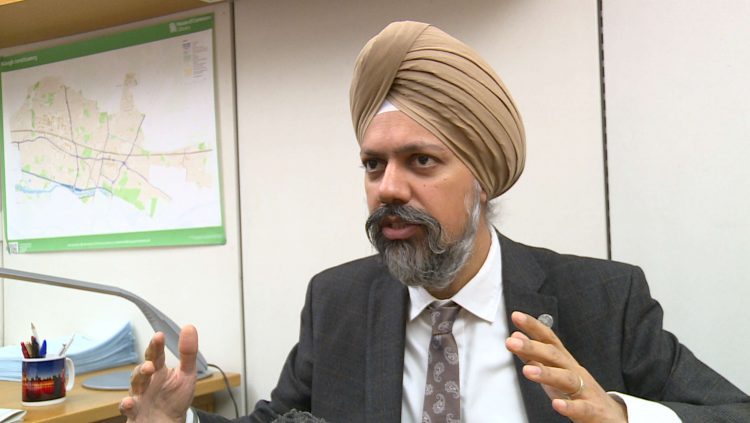
Tanmanjeet Singh Dhesi’s journey to becoming the first ever ethnic minority Chair of the House of Commons Defence Committee is a powerful story of family, identity and public service.
His path begins in Slough—the town he now proudly serves as MP.
Dhesi was born in Slough, where his parents worked long hours to build a new life. His father worked at the Ford factory in Chalvey and his mother at a petrol pump company on Farnham Road. “My parents bought their first ever house in the UK in Slough,” he recalls.
At age four, his parents made a decision that shaped him: they sent him to Punjab so he could grow up with strong cultural roots. “They wanted me to get the best of both worlds – both the Punjabi culture and traditions, and to maintain links with family back in India.”
He returned to Britain at nine, moving to Gravesend, completing school, and later going to university. Politics was never the goal at that time. “My aim in life wasn’t to become an MP. I wanted to run my own small business, following in my parents’ footsteps.” He went on to run a construction company in Scotland and spent over twenty years in the industry.
In 2017, Tan Dhesi became the first turban-wearing Sikh MP in the UK and Europe—a moment that meant a great deal to many communities. “It was a watershed moment and it made Punjabis very proud… but I think everybody in the country saw it as a collective achievement,” he says.
In 2024, he made history again when MPs elected him as the first ethnic minority Chair of the Defence Committee. “To become Chair, you need the trust of more than 300 MPs… so I’m very grateful they put their faith in me,” he says.
His role now is to question ministers, visit military bases, study reports, and help keep the UK safe. “We are the government’s scrutineers in chief. We make sure all the difficult questions are asked,” he explains.
Being an MP brings daily challenges. “Every day is different. Sometimes you’re dealing with a constituent in tears because they’re homeless or facing problems with their children’s education,” he explains. “Other times you’re reading detailed defence information or preparing for big debates.”
One moment that reached the world was his question to Boris Johnson about racist remarks back in 2021. “I thought it was important to call out divisive and derogatory comments… we can’t allow such language to be normalised.” The speech went viral, and he was taken aback by how widely it resonated.
Dhesi speaks with great pride about Slough. “Slough is an economic powerhouse for the country,” he says. The town has:
- one of the world’s largest concentrations of data centres
- more than 100 languages spoken
- one of the youngest populations in the UK
- excellent GCSE and A-Level results
- one of the highest start-up rates in Britain
But the town also has challenges. “We have pockets of deprivation and overcrowding. Many families are struggling with housing and costs.” That’s why he supports measures like free breakfast clubs and expanded school meals. “These give young people a level playing field so they can fulfil their potential.”
Identity is something Dhesi embraces openly. “Identity is contextual. If I’m at the gurdwara, I’m proud to be Sikh. If I’m watching the England team, I’m proud to be English. At the Olympics, I’m proud to be British.”
He continues to take his children to Punjab so they understand their heritage. “You should be proud of your history and your culture, but also proud to be part of the wider community. It’s not about assimilation – it’s about integration.”
Balancing Parliament, constituency work, and family life is his biggest ongoing challenge. “There are so many balls to juggle and not enough hours in the day,” he admits.
Still, he hopes young people consider public service. “Politics affects every part of our lives. I hope young people will want to serve their community—whether as councillors or volunteers.”
From a childhood between Slough and Punjab, to becoming the first turbaned Sikh MP, to leading one of Parliament’s most important committees, Tan Dhesi’s journey shows what is possible through determination and community support.
“There will always be obstacles, but we owe it to ourselves and our country to make a positive contribution,” he says.
As the first to break barriers in Parliament, his journey shows not only what he has achieved—but how many others can now follow.